


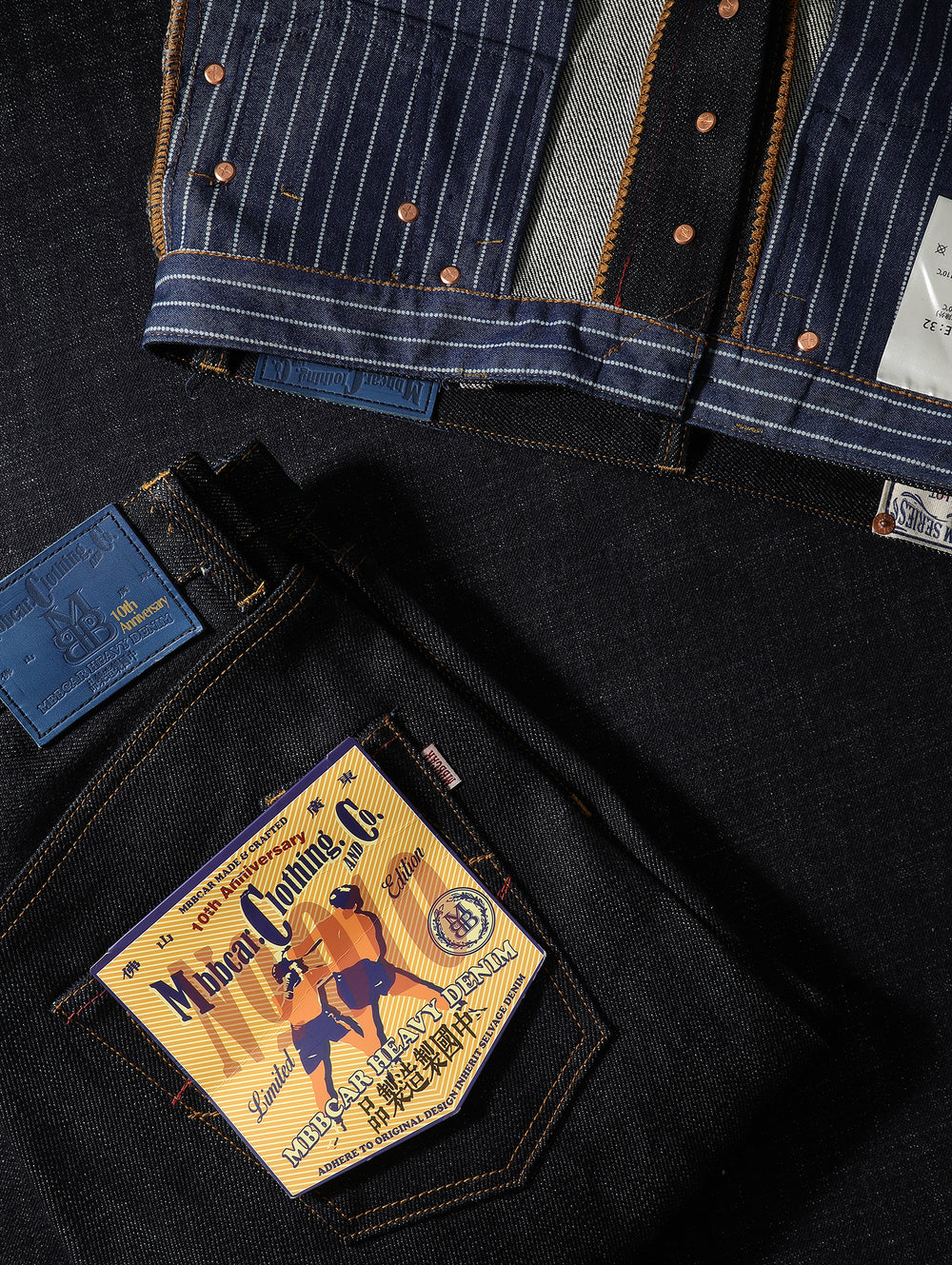


ANIMAL Series Panda Straight-Leg Selvedge Denim jeans
Unwashed

One Wash

Panda(Scientific name:Ailuropoda melanoleuca)

The giant panda belongs to the order carnivora and the family ursidae, and is the only mammal in the subfamily ailuropodinae and genus ailuropoda.
It has a round, plump body with a large head and a short tail, with males slightly larger than females.
Its black-and-white coloration features distinctive black eye patches and an iconic pigeon-toed gait, along with claws as sharp as surgical blades.
The panda’s skin is thick, reaching up to 10 mm at its thickest point.
Its contrasting black-and-white appearance helps it stay concealed in dense forests and snowy environments, making it less visible to predators.
The giant panda is endemic to China, mainly inhabiting mountainous regions in Sichuan, Shaanxi, and Gansu.
It lives in dense bamboo forests at elevations of 2600–3500 meters, where the air is thin, mist is frequent, and temperatures remain below 20°C.
These environments provide abundant bamboo, suitable terrain, and water sources, which support nesting, sheltering, and raising young.
Giant pandas are skilled climbers and also enjoy playing.
Tree climbing often occurs during mating season, when avoiding danger, or when weaker individuals avoid stronger ones.
They spend about half of their day eating, while most of the remaining time is spent sleeping. In the wild, they sleep for 2–4 hours between feeding sessions.
Around 99% of their diet consists of bamboo, with over 60 species across 12 genera available for consumption.
Wild pandas typically live 18–20 years, while those in captivity can live over 30 years.
Having existed on earth for at least 8 million years, the giant panda is known as a “living fossil” and a “national treasure of China,” serving as a flagship species for global biodiversity conservation.
In 2013, CNN ranked it third on the list of the world’s cutest animals.
In 2019,
MBBCAR selected nine wild animals from China as representatives to raise awareness about understanding viruses at their root and discouraging the hunting of wildlife. These animals were incorporated into leather patches, tags, and packaging as a way to remind people not to make harmful choices, while simply recording their population numbers.
In 2026,
we decided to relaunch the animal series as a way to reflect on whether the call to protect wildlife from seven years ago has truly been fulfilled.
The leather patches, tags, and packaging retain the first-generation animal series design, while the numbers printed on the second-generation pocket lining represent the current population of these wild animals.
By comparing these with the numbers on the leather patches and tags, the changes over the past seven years become visible.
An embossed animal graphic is added to the left back pocket, and the inner waistband features an exclusive lining for the animal series.
As of 2026, the wild population of giant pandas
has recovered from approximately 1,100 in the 1980s to nearly 1,900.
- 14.5oz vintage loom selvedge denim fabric (100% cotton)
- Custom YKK MBBCAR tack button and rivets
- 701 straight-leg jeans
- Mid waist
- Button fly
- Leather patch(The graphic is applied using screen printing and will gradually age and fade with wear)
- Raw
- Machine washable
- Shrinkage rate:Expect 0.8"-1"/2-2.5cm horizontal shrinkage and 1.6"-2.0"/4-5cm vertical shrinkage
- Raw denim may bleed color significantly during the first few wears. To avoid staining, please avoid pairing it with light-colored garments
- Dyed with indigo. Due to the natural characteristics of this material, the coloring may rub off onto fabrics and upholstery
The fabric is not singed, so there is a noticeable amount of surface fuzz.
It has also undergone a dry skewing process, making it feel quite stiff on the first wear after washing, requiring 2–3 days to break in.
The waistband lining uses a custom acetate double-sided satin from the animal series, offering a soft and smooth feel against the skin.
The leather patch is made from imported Italian hide using a semi-vegetable tanning process with screen printing, and the print will gradually fade with wear.
The pocket lining is made from HBT herringbone 100% cotton fabric.
Model:5'10"/178cm & 143lbs/65kg,size 30
Unwashed
One Wash

- After the order has been paid, the warehouse needs 1-3 days to process your order.
- During holidays and peak sales, your order processing may be delayed, but we will process and ship as soon as possible.
- Order changes and cancellations can only be made before shipment.
All international orders will be shipped out directly from our China-based studio via Yun Express, with packages potentially reaching most destination countries within the following timeframes:
Express Shipping(Yun Express): About 4-15 working days.
Style it with

